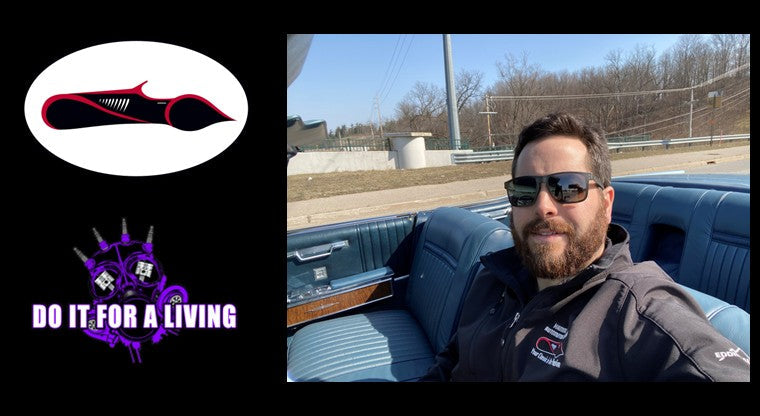

Most guests on Do It For A Living had been running shops for years. Lee Sweitzer hadn't opened his yet. In 2016, Kevin Dubois met him at an Essentials of Operating a Shop class in San Jose and asked him on to talk about starting a performance shop the right way, from the beginning.
Lee was a Marine with about 60 days left on an eight-year enlistment. On the day of the interview he had just picked up the keys to a 1,000 square foot space for Sweitzer Performance, a Ford performance and drag racing shop in Southern California. He was already doing work there part time at night and on weekends, and had set a grand opening date of October 1.
His approach was unusual for a new shop owner. He had a 46-page business plan, a target revenue, a hiring schedule and a workflow he was following on his own before he hired anyone. This article covers that plan and how he built it.
From the drag strip to the Marine Corps
Lee grew up at the track. His father drag raced a Fox Body Mustang, and the family spent nearly every weekend at the strip. At 15 Lee got his first car, a black 1984 Mustang 5.0 that had sat in the backyard as a parts car. He couldn't tune the carburetor, so it wouldn't idle by itself, and it broke about once a week. He drove it to school every day anyway.
He joined the Marines at 17, right after high school, and deployed to Afghanistan twice. He was stationed close to home, so he kept racing with his father. When he reenlisted four years before the interview, he already knew he wanted his own business. Leaving meant giving up a guaranteed paycheck, free medical care and a pension at 37. He said he was leaving the service to do this, which he saw as different from leaving the service and then figuring out what came next.
If you want something bad enough, you make it happen, and that's it, period.
He tied that belief to the Crucible, the 56-hour final test of Marine boot camp, which ends with a steep hike and the Eagle, Globe and Anchor placed in your hand.
Start with the life you want and work backward
Lee planned his business by deciding what he wanted his life to look like first. His goal was a 3,000 to 4,000 square foot shop he could come into four or five days a week because he wanted to, with time to race and be with his family. Then he worked out what that required. The business would need to bring in about a million dollars a year with five full-time employees and one part-timer: three techs, a shop manager, a service writer and a part-time helper.
That vision came from The E-Myth Revisited, one of his two favorite books along with Good to Great. Lee said most performance shop owners were techs first and assume being good at the work is enough. He wanted the business to work for him, so he wouldn't end up turning wrenches with no savings and nothing to sell.
This was also his action item for listeners. Set your business aside for a moment and ask what you want your life to look like. Work backward to how much money that takes, how much the business has to generate and how many people it needs. The result is a list of milestones. Take the first one and start pushing.
What went into a 46-page business plan
Lee had assumed every new business owner wrote a business plan, and he was surprised to hear most shop owners on the podcast hadn't. His longest version ran 46 pages. He said writing it was as much a test for himself as a document for a bank.
It opened with an executive summary covering who the shop was, who it would serve and how. The market analysis used SEMA and census data to estimate the local population, average household income and cars per household. For racers, he counted nearby tracks, estimated how many people raced at them regularly and what share he could hope to capture. There were three drag strips within 70 miles, and the nearest Ford performance specialist was almost 100 miles away.
He was blunt about financial projections. The first year might come close, and anything after that is a crystal ball. His rule was to take what you honestly think you can achieve and cut about 30 percent. If the number still works, you may have something. If your best case barely gets you by, look at a different market or business. Kevin added a point Todd had made, that a plan where every number has to be fudged is telling you the business may not be viable.
Hiring slowly and building systems first
Lee's hiring plan was staged. In August or September he would add a second tech and a service writer, partly because he didn't consider himself a strong salesman. A second full-time tech would follow by the next spring, which would take Lee out of the shop full time. Within about two years he wanted a third tech, ideally one who could move up to shop manager. He preferred to grow managers from within, because people hired with management experience often bring bad habits with them.
Before anyone was hired, he was already using My Shop Assist and QuickBooks Online, and he aimed to stay paperless. He made himself follow his own process for every car that came in, even though it felt tedious as a one-man shop.
If those systems are perfected before they show up, it's a whole lot easier to hold them to that standard, because it'll be that way from day one.
He added that talented people won't stay long at a shop that hires them first and figures things out later.
Know your market and say no
Lee planned on two groups of customers. The first was Ford street enthusiasts, Mustang and Lightning owners, including people who want to go fast without doing the work themselves. The second was bracket racers, the group he knew best. Bracket racing rewards consistency over raw speed, and those racers want the best parts and the smallest edge. His own Fox Body, which ran 9.80s with the shop name on it, was his best marketing. One customer came to the track just to watch it run, and his 1,000 horsepower Fox Body was in Lee's shop afterward.
The plan called for parts and service at about 50/50. Lee's biggest frustration so far was customers treating performance work as a commodity and comparing his prices to a big online parts retailer. He thought about three out of four estimate requests came from price shoppers, and his answer was to educate them. Kevin said his own shop had been about 50/50 parts and service in 2014, but online price shopping had cut into parts sales while service stayed steady.
For marketing, Lee used targeted Facebook ads and an 80/20 rule. Eighty percent of posts showed cars, race results and wheelies, and twenty percent promoted a product or service. He kept every dollar of profit in the business, taking nothing out while it grew. The biggest lesson he had taken from the podcast was that you can't be everything for everybody, and saying no to the right work does more good than saying yes to everything.
His biggest challenge
Lee expected his hardest adjustment to be people. As a Marine noncommissioned officer, managing people was his whole job, and it covered every part of their lives. That made leading a shop crew look almost easy. His habit of getting loud to get things done would not work with customers or civilian employees, and he said he had to stay very conscious of it. He said he would hire whoever was most qualified and fit the shop best, veteran or not.
Key takeaways
- Decide what you want your life to look like, then work backward to revenue, staff and milestones.
- Write the plan down, with real market data, before you sign a lease.
- Cut your honest projections by about 30 percent. If they still work, keep going.
- Build and follow your systems before you hire, so new staff learn them from day one.
- Pick a market you know from the inside, and turn down work that doesn't fit it.
- Stay flexible on space for the first few years before you buy a building.
Setting up a new shop with My Shop Assist
Lee's plan depended on having systems in place before his first hire. My Shop Assist gives a new shop that structure from the start. Every job carries its tasks, parts and tracked time, so you can see what work really earns. Checklists and forms turn your intake process into steps every tech follows. Purchase orders handle parts, text messaging keeps customers updated, and jobs export to QuickBooks. Read how MSA works for performance and racing shops.
If you are planning your own opening, start a free 30-day trial and build your workflow before the first customer arrives.