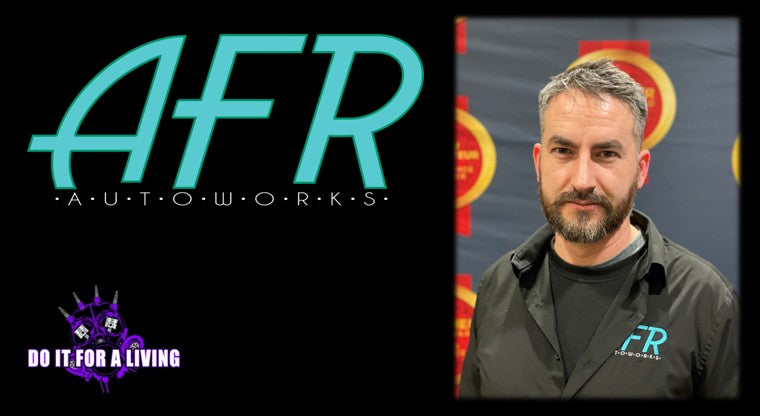

Adam McCreery owns AFR Autoworks in Red Deer, Alberta, a performance, tuning, service and light fabrication shop he co-founded in 2013. In late 2024 the shop had a 4,800-square-foot building, three bays, six hoists, an all-wheel-drive dyno, a fab area and an engine room, with a crew of five to seven people. Adam still did the tuning himself.
Adam had been a My Shop Assist customer for years and often talked shop management with host Kevin Dubois. This episode covers how he went from losing money every month to taking his first family vacation in ten years, and the spreadsheet he uses to find his effective hourly rate.
From shop teacher to shop owner
Adam grew up in northern British Columbia, where his dad made the kids fix their own minibikes. He trained to be a high school shop teacher at BCIT and UBC. When his teaching job didn't open up, he started a journeyman apprenticeship in Alberta and never went back.
AFR stands for Adam, Floyd and Roy, the three friends who opened the shop in a single bay in the fall of 2013. For a year and a half Adam worked three long dealership shifts a week and spent the other three days at AFR, which paid for equipment. When he broke his foot skateboarding, the dealership wouldn't take him back, so he rested his knee on a rolling chair and went full time at AFR. He wanted to be a tuner, and nobody hires a tech off the street to tune. Adam bought out Roy, the last remaining partner, about five years before the recording.
The worst year and what it taught him
About six or seven years earlier, with seven employees, the shop fell behind on payroll remittances and GST. Those are trust funds in Canada, and the government can come after the owner personally for them. When money ran short at the end of the month, Adam paid his people first. The debt built up fast. He set up a payment plan with the Canada Revenue Agency, but the documents his bookkeeper was supposed to send never arrived, and the CRA froze the shop's accounts. He flipped cars and used his personal credit and line of credit to keep parts on order.
At the time he was working 80 or more hours a week.
I didn't own the shop. It owned me.
That is when he bought out his partner, brought in My Shop Assist and started listening to this podcast. He said it was hard to find any information on running a performance shop.
Why the shop was busy and still losing money
At a dealership Adam usually billed 170 to 200 hours a month, roughly 100 to 115 percent efficiency. At his own shop he never saw better than 40 to 45 percent, and it averaged 35 to 40 percent when he started using shop software. When the crew was small, he could cover a bad month by working 18-hour days. With seven or eight people, that stopped working. If six techs each bill an hour a day less than they should, the owner can't stay late and make up six hours.
He found the leaks. Approvals weren't in writing, so customers and the shop disagreed on totals at pickup. Estimates meant looking up every part price and labor time by hand. A missing part could kill half a day. The car gets pushed in, the first part isn't there, and it's 11 a.m. with nothing billable done. Adam said the real problem was that he hadn't given his techs the systems and tools to succeed.
Kevin added that performance work has no book times. The first time you track a custom job, you have a real number for the next estimate.
The effective hourly rate spreadsheet
Adam borrowed the idea from a friend who runs a heating and air conditioning company. That business thinks in trucks. Each truck has two techs, a set cost and a set number of hours to bill. Get one truck profitable, then add another. Adam did the same with bays.
- He lists every fixed cost, payroll cost and debt payment, including the dyno, the tool truck bill, loans and tax payment plans.
- For each tech he enters the full wage cost per hour with benefits and taxes, the total hours worked and the hours billed. That gives each person's efficiency and a wage cost per billable hour.
- He splits overhead across the techs and divides it by their billed hours to get a total cost per billable hour for each person.
- Warranty work goes on a shop work order. The tech who fixes a comeback gets credit for the hours. If the comeback came from someone's mistake, it counts against that person's efficiency, including Adam's own.
A small change in efficiency makes a wild difference in cost per billable hour. An hour a day across about 1,900 working hours a year is a huge amount of billable time. Kevin recalled that in the shop management classes he used to teach, a tech below roughly 70 percent efficiency could end up costing the shop more than he brings in.
At year end Adam enters the actual numbers from his accountant and checks that the sheet matches the real profit or loss. He also compares the labor My Shop Assist calculated against what was actually invoiced in QuickBooks. He calls the gap his office efficiency number, and it has improved every year. Fixed-price work has to be backed out first. The shop did 261 oil changes at $35 of labor each, well under shop rate. After those corrections, his sheet landed within a few percent of the real result.
Then he runs what-ifs. He tests another tech, knowing efficiency usually drops when the crew grows. He tests a cheaper building with less space, or a $160 shop rate, and what happens if that rate costs him 10 percent of his work. Six months into the first year, he recalculated and found his effective hourly rate was many dollars above what he was charging. So he raised it.
Pay, meetings and buy-in
Adam pays everyone hourly. He tried flat rate and saw techs rush work. After three months, employees get health benefits that cover about 80 percent of things like dental, massage and chiropractic up to a limit.
Every Monday the team reviews the prior week's efficiency. Adam said he isn't afraid to call out poor performance, but each conversation ends with a plan to fix the problem. Often a bad week traces back to a job Adam shouldn't have assigned or taken in.
The shop implemented My Shop Assist twice. The first attempt, while he still had a partner, never fully stuck. The second time he explained why and got the core team on board. Now it's a condition of the job. Anyone who won't put notes in the system or communicate with customers through it won't be working there.
Margins, marketing and the buddy deal
About 45 percent of AFR's revenue came from parts, close to 10 percent from its online store and the rest from labor. Nearly everything comes from the United States, so shipping, brokerage and duty eat into margins. A 15 percent discount that leaves a U.S. shop about 10 percent might leave Adam only a few percent. One bad shipping estimate on a web order cost him a couple hundred dollars.
Performance marketing for AFR is the track, helping people there and word of mouth. Adam said general repair shops live and die by Google reviews, while performance customers want to know who tuned the fast car. The shop's Subaru Impreza drag car, built on a tight budget from flipped parts, ran a 9.1 at 162 mph on a stock transmission.
His first piece of advice was to calculate your effective hourly rate and stop doing cheap work for friends.
Every hour I work on so-and-so's car on the buddy deal, I'm actually paying $40 to work on their car.
He recommended Profit First by Mike Michalowicz, The One Thing by Gary Keller and Selling the Invisible by Harry Beckwith. His own "one thing" is making sure each tech has the work, the parts and the instructions every morning to bill the hours the shop needs.
Key takeaways
- Calculate your effective hourly rate from fixed costs, payroll and debt payments, then add a margin.
- Track each tech's full wage cost per billable hour. Small changes in efficiency swing profit a lot.
- Check your numbers against the year-end books, and track the gap between calculated labor and invoiced labor.
- Test a new hire, a rate increase or a move on paper before you do it.
- Get approvals in writing and order every part before the car comes in.
- Stay current on payroll and sales tax remittances. In Canada they are trust funds.
Running the numbers in My Shop Assist
Adam's process needs hours worked against hours billed for every tech. My Shop Assist tracks time on every job and task and handles all three pricing types, keeps parts and purchase orders on the job so missing parts show up before the car is pulled in, and exports invoices to QuickBooks for the year-end comparison. Text messaging keeps customers in the loop before they come to pick up. See how MSA works for performance and racing shops.
If you don't know your effective hourly rate yet, start a free 30-day trial and start collecting the hours you need to work it out.