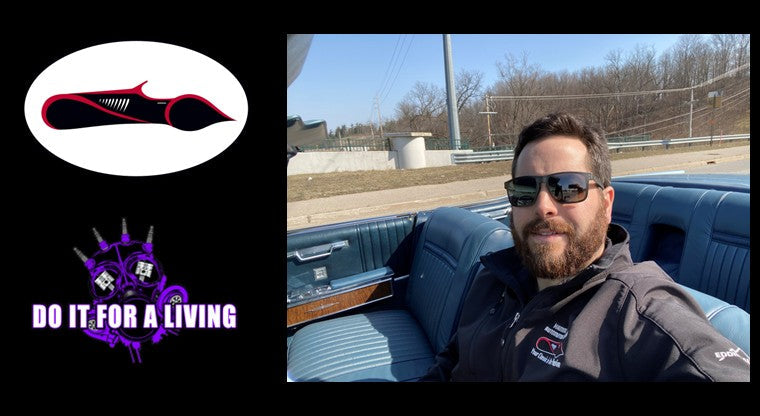

Adam Hammer owns Hammer and Dolly Restorations in Traverse City, Michigan, a classic car shop that does body, upholstery and mechanical work under one roof. When this episode was recorded in early 2025, he had ten people, two buildings he owned, and enough service work to be booked out until August.
Adam had been a My Shop Assist customer for close to ten years. Host Kevin Dubois invited him on because his operation is one of the most organized restoration shops Kevin had seen.
This article covers how Adam documents a two-year restoration, why he bills every week, how he talks to customers about bad surprises, and how he hires and pays a crew in a trade with very few trained people.
A degree in restoration
Adam learned to wrench on go-karts, minibikes and the family cars with his dad. He went on to McPherson College in Kansas, which he said is the only school in the country with a four-year bachelor's degree in automotive restoration. He took a semester of nearly everything: woodworking, upholstery, paint and body, machining, engines, transmissions, chassis and foundry work. He said he didn't graduate an expert, but he left with a wide view of what was possible.
After school he worked as a fabricator at a Rolls-Royce restoration shop in Ohio. The owner and some of his managers came from IndyCar crews, and Adam learned how to build things from scratch and do it quickly. He then worked for a private collector. He moved to Traverse City in August 2011 and did 1099 work on the project cars sitting in the corners of local body shops. By March 2012 he was self-employed. At first it was mostly mechanical work, such as carburetor rebuilds and tuning that most shops no longer want to touch. Word of mouth has been his main sales tool ever since.
The shop in 2025
Hammer and Dolly works out of a 10,500-square-foot building, with a 5,000-square-foot second building for overflow and winter storage. Adam had owned both for three or four years and liked that nobody else could dictate his space or raise his rent. The main shop holds about 12 cars comfortably and 18 if packed bumper to bumper. It has three two-post lifts, a mid-rise and a drive-on lift.
The storage building holds about 25 customer cars each winter plus about ten overflow projects. Storage cars need work too, so the crew rotates them through in the winter and has them ready for spring.
The team was Adam, a parts and project manager named Brad, four mechanics and four body and assembly techs, one of them an intern. Revenue was all labor plus the parts that labor requires. Adam didn't sell parts on their own or build cars to sell. A complete restoration can run $200,000 to $300,000 or more, and he wanted any car with his name on it to get the same work a client's car gets.
Many of his customers are retirees who moved to the area and bring their toys with them. Nobody else in the region he knew of did body, upholstery and mechanical work in one place.
Document everything before it comes apart
Adam said a full restoration has never taken less than 2,000 hours, and lately they run 2,500 to 3,500. That is more than a year of one person's full-time work, and the projects last about two years. Staff can come and go in that time, so the first step of every teardown is what Adam calls documentation and inventory.
- A tech photographs the exterior from about 20 angles, plus close-ups of anything unusual.
- Under the hood, under the chassis and in the interior, each area is shot from far away and then closer in, so the photos show how the car goes together.
- Photos continue through the whole teardown. A finished disassembly has 600 to 1,000 photos.
- Every part is bagged, tagged and cataloged. Chrome and plating parts are set aside to ship out, the interior goes to the upholstery shop, and the stripped body goes out for media blasting.
Adam tries to be part of every teardown himself, with his project manager, so the information doesn't leave with an employee.
You can never have enough photos. You can never have enough notes.
That record also protected him in his worst experience in business. A client upset about how long his project was taking threatened to sue. Adam had dates, times and correspondence in My Shop Assist showing he had done what the client asked. He wrote the client a letter laying it all out, and that ended it without lawyers. Adam later learned the man had received a bad medical diagnosis, which made the whole thing harder to take.
Weekly billing and honest numbers
Adam started with monthly billing and found it didn't keep up with the cash flow a growing shop needs. He moved to every two weeks, then to weekly. Now any car with $1,000 or more of work that week gets an invoice. He said clients can easily read through a bill under $5,000. Above $10,000, they start questioning it. He never wants a client doubting his honesty, so each invoice shows the exact time, such as 5.63 hours on a task, with notes and photos. He said a bill should never just read "restore car, $10,000."
When he sells a big job, he gives clients big, honest numbers up front and warns them about surprises, much like someone restoring an old house who opens a wall and finds the project has doubled. He also changed how he delivers that kind of news. One car came back from the blaster with a floor that turned out to be street signs and beer boxes.
I've got to give you some news, and you get to decide if it's good news or bad news.
Most communication over a two-year project runs through the invoices and photo updates. Clients are welcome to visit, and the techs like showing off their work. At the end, each client gets a USB drive of photos. Afterward, Adam hosts Cars and Coffee at the shop twice a year, sends the odd card, and gives clients his cell number. If a car breaks down on the road, he shows up with his truck and trailer.
Scheduling, hiring and pay
Restoration work comes and goes in ways that are hard to predict. Adam joked that an oil change and a restoration can arrive and leave on the same days, because the oil change turns into a bigger job. He used to schedule four big restorations a year and cut back to two or three to give the shop breathing room. The plan is two big projects with a solid crew and a known timeline, with smaller work filling the gaps. On the service side he books one or two new cars a week and expected to handle 75 to 100 cars in the year.
Few new hires show up already able to do CAD, weld aluminum, run a planishing hammer or build an engine. Adam hires for aptitude instead, looking for people who are curious, ask questions and can think ahead. No two classic cars are alike after decades of other mechanics, so a lot of the work is reverse engineering.
He had high turnover in the past and worked hard on retention after COVID. Everyone gets 100 hours of paid time off, seven holidays plus their birthday, a 3 percent SIMPLE IRA match and fully paid health insurance. Retraining costs money, and in a niche trade he wants to teach someone once and keep them.
Adam reviews his shop rate against wages, benefits and operating costs every year or two and adjusts it. If he went broke using his skills, he said, he wouldn't be fair to himself. He keeps his own hand on the money too. He does the invoicing, bill paying and payroll, and his accountant reconciles the books and files the state forms and payroll taxes.
His biggest struggle was his own time management. He tends to take on more work that only he can do than any day allows.
Key takeaways
- Photograph and catalog every car before and during teardown. It protects the shop and outlasts any one employee.
- Bill weekly on long projects with exact hours, notes and photos so invoices stay small enough to read.
- Give big, honest estimates up front and present surprises as news the client gets to judge.
- Limit big projects to what the crew can finish on a known timeline, and fill gaps with service work.
- Hire for aptitude and curiosity, then pay and treat people well enough to keep them.
- Review your shop rate against your real costs every year or two.
Running a restoration shop with My Shop Assist
Adam's system depends on a clear record of the work. Before My Shop Assist, he typed up stories in QuickBooks from about five handwritten time cards a day. Now hours are tracked on each task, photos and notes stay on the job, and invoices with those details go out every week. MSA handles progress billing for long builds, parts and purchase orders tied to each job, checklists for steps like teardown, text messaging with clients and export to QuickBooks. Read more about how MSA works for restoration and hot rod shops.
If you want that kind of documentation for your own builds, start a free 30-day trial.